GPT and Claude are moving in different directions
OpenAI and Anthropic released new flagship models just a week apart. Claude Opus 4.7 came out on April 16, and GPT-5.5 followed on April 23. Both companies call their models the best. And technically, they are not wrong: they are simply the best at different things.
Let’s look at the specifics. Claude clearly leads in academic and reasoning benchmarks: it scored 94.2% on GPQA Diamond, and its HLE results are also higher than competitors. GPT-5.5 takes the lead in terminal-based scenarios and mathematics: it achieved 82.7% on Terminal-Bench 2.0 compared to Claude’s 69.4%. Each model is stronger where the other is weaker, and this is not a random fluctuation. In practice, Claude handles high-level architectural thinking across large codebases better, while GPT-5.5 is more precise when it comes to file navigation and working with specific tools.
This is not accidental. Both companies have deliberately focused on different use cases, and this is shaping the direction of the entire industry. If the question used to be “which AI is the best,” the better question now is: “which tool is best for a specific task?”
The market reflects the same shift
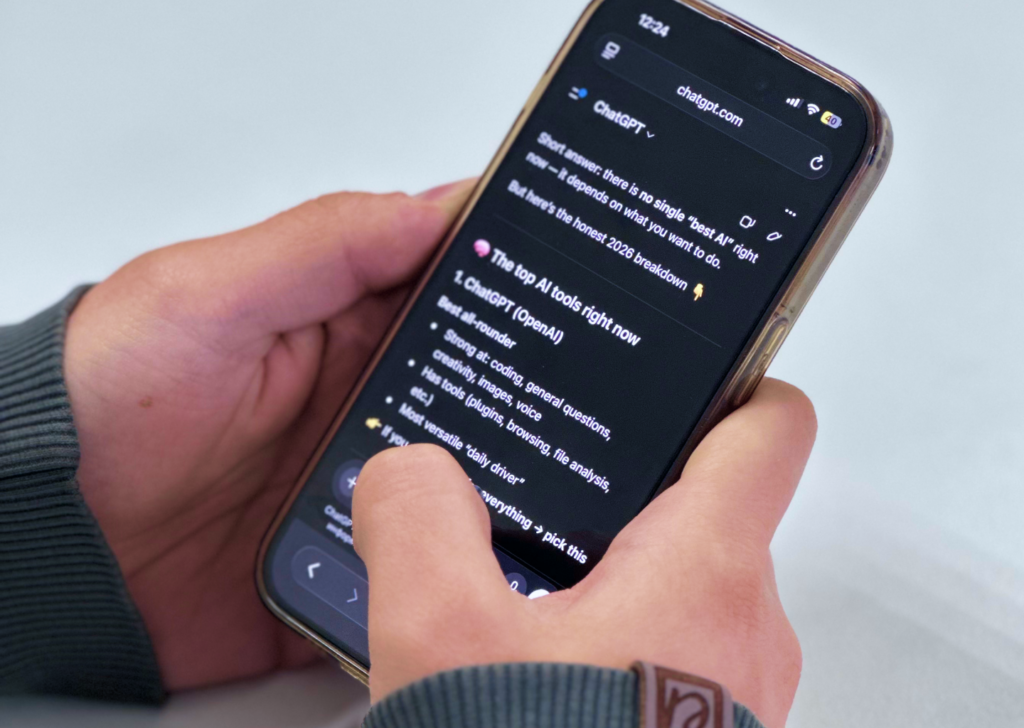
Looking at the bigger picture, ChatGPT remains the best generalist, but in each specific category it is outperformed by specialized tools. Gemini excels in Google Workspace integration and context window size. Perplexity has become the standard for research, providing sourced answers where others hallucinate. Cursor has saved developers significant time precisely because it focuses on doing one thing exceptionally well. Midjourney remains the gold standard for image generation in terms of quality and artistic control.
| Tool | Best at | Weaker at | For whom |
|---|---|---|---|
| ChatGPT (GPT-5.5) | General tasks, agent-based coding, voice mode, file navigation | Deep analysis and long documents | Everyone, developers |
| Claude (Opus 4.7) | Complex code, long documents, reasoning, precise instruction following | Voice, video, real-time search | Developers, analysts |
| Gemini | Google Workspace, video and audio, massive context | Weaker outside the Google ecosystem | Google users |
| Perplexity | Research with sources, up-to-date data | Not for content generation | Researchers |
| Cursor | Coding in IDE, understanding the entire project | Only for developers | Developers |
| Midjourney | Artistic images, marketing visuals | Text in images, editing | Designers, marketing |
The era of a single universal AI is ending. Those who build the right stack for their tasks are winning.
How to write prompts for GPT-5.5: three rules
Alongside the release, OpenAI published a new prompting guide, and its essence can be summed up in one sentence: with the old approach to prompts, the new model performs worse than it could.
Previously, users and developers described every step: explaining what to do, in what order, and with what constraints. This was necessary because earlier models needed detailed instructions or they would lose direction. Now the situation has changed. GPT-5.5 often performs better when you describe the goal rather than the path — detailed step-by-step instructions can limit the solution space.
OpenAI recommends a different approach:
- Describe the desired outcome
- Define the constraints
- Explain what counts as a good result
How exactly to get there — in many cases, the model performs better when allowed to choose the path itself.
For regular users, this is good news: the barrier to entry is lower, and there is no longer a need to learn “proper prompting.” For developers who have spent years building complex system prompts, this becomes a full-fledged migration project. Old instructions have turned into technical debt.
Both events this week — the release of two flagship models and the shift in prompting practices — point to the same conclusion: the AI industry has moved from a phase of competition into a phase of specialization. Tools are becoming smarter, carving out their niches, and requiring less manual control.
The question is no longer which AI is the best. The question is which one you need at this stage of your task.