When the rules of the game change
Imagine: teams are rotating, new vendors are coming in, and the platform serves multiple stores across different regions. Each with its own business and tax rules, currencies, and payment providers. On top of that, dozens of integrations: PIM, ERP, WMS, CRM, Marketing and SEO tools.
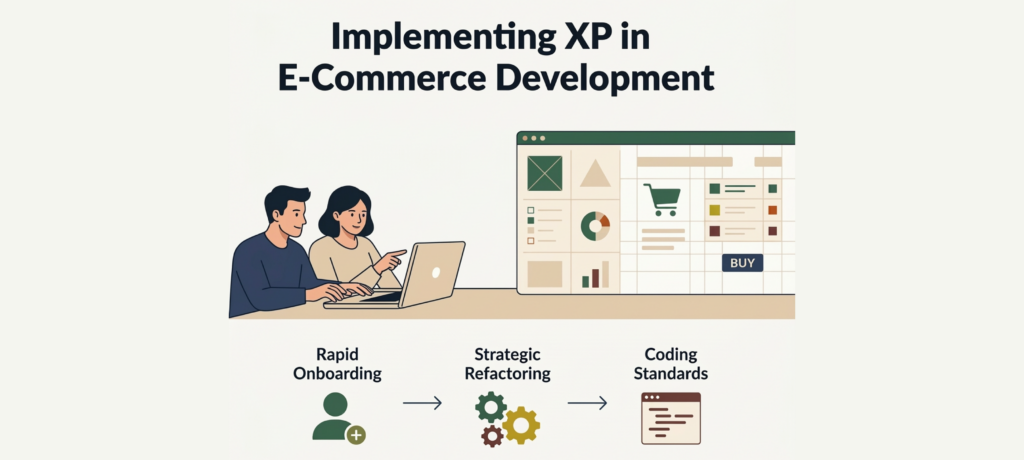
That is exactly where we found ourselves. Onboarding a new developer took up to four weeks. The codebase was growing “fear zones”, modules no one wanted to touch because no one fully understood how they worked. Bugs from one region leaked into another. Every release felt like a lottery.
We needed more than just a new process. We needed something like an immune system: a mechanism that does not treat diseases after the fact but recognizes threats early and develops “antibodies” against them. For us, that system became Extreme Programming (XP) practices.
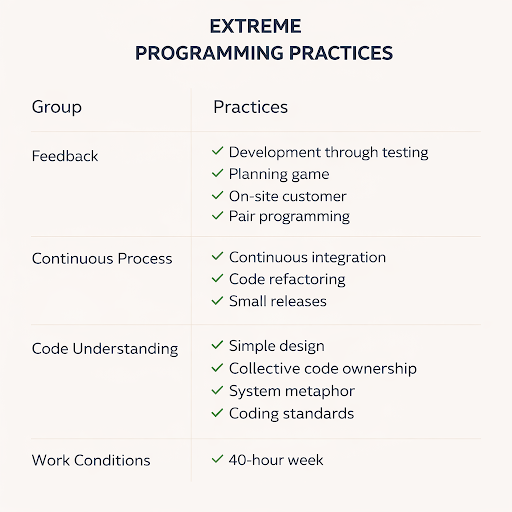
XP is built around four groups of practices: Feedback, Continual Process, Code Understanding, and Work Conditions. Below is how each of them works on our project and what specific results it delivers.
1. Feedback: design as a contract
In classic XP, the first line of defense is tests. Development is driven by tests (Test-Driven Development), and they immediately signal problems. Without full test coverage, the role of that “early signal” on our project was taken over by the Technical Brief.
Technical Brief instead of blind development. Before the first line of code, the team prepares a detailed document: positive and negative scenarios, architectural decisions, integration points. In essence, it is a contract between the business analyst and the developer. A contract that provides confidence before work even begins and eliminates the category of bugs like “I didn’t know that could happen too.” If TDD provides early feedback through tests, the Technical Brief provides it at the level of change design and business logic.
Pair Programming for complex zones. Pair sessions are applied selectively: for high-complexity tasks or “historically tangled” modules. When changing tax calculation logic for different regions, for example, a newcomer sits down with an experienced team lead and they walk through the legacy code together. The newcomer gains context; the lead gets a fresh perspective and instant review. This approach reduced the number of bugs caught at the code review stage by 1.5 times.
On-site Customer and Planning Game. Working with a product company gives us direct access to the business. Tasks are estimated based on real complexity and dependencies, not abstract units. Stakeholders see the full picture: “The feature is simple on the front end, but the ERP integration work makes it expensive.” This eliminates conflicts at the prioritization stage rather than in the middle of a release.
2. Continual Process: preemptive refactoring
If feedback is the body’s ability to recognize a threat, then a continual process is its ability to regenerate. Code that is not updated becomes brittle. But refactoring for the sake of refactoring is a waste of resources. That is why we tie it to business goals.
Payment providers case. At the beginning of each quarter, we analyze the Roadmap. Say in three months we need to connect five new payment providers, and the current architecture is not built for that kind of scaling. Instead of heroically cramming new code into an old structure a week before the deadline, infrastructure preparation tasks are created well in advance.
Infrastructure Enablers. Interfaces are updated, shared logic is extracted into separate modules, and the code is merged into the main branch long before work on a specific provider begins. By the time business development starts, the platform is already ready to scale. The developer does not fight the architecture but simply implements business logic.
How critical this alignment with the roadmap really is was clearly demonstrated by our case of decomposing a monolithic Angular component. The refactoring was completed cleanly and on time, but shortly after, the client revised the screen concept and the branch had to be archived. The engineering experience was not lost: approaches to separating responsibilities and building component APIs are applied on other tasks. But the case itself became a vivid argument for the team: planned refactoring must be aligned not only with the technical state of the code but also with where the product is heading.
Human-driven CI. CI/CD pipelines catch syntax errors and failing tests. But on a multi-regional platform, something else matters more: will a change for one region break something in another? Tech leads perform this check through manual review of every Merge Request.
Planned refactoring must be aligned not only with the technical state of the code but also with where the product is heading.
Small Releases. After each refactoring, thorough testing is conducted: changes for region “A” must not affect business logic in region “B.” Only after that verification does code go to production in small, safe increments. Release frequency has increased, while the number of “surprises” in production has decreased.
3. Code Understanding: a single charter for all teams
An immune system works because it can tell “self” from “non-self.” The same logic applies to code: when multiple teams and vendors work on a project, Collective Code Ownership without strict rules turns into collective irresponsibility.
Coding Standards. Everything is documented: from variable naming rules to error-handling patterns at integration points. This is not a recommendation, it is project law. Every new developer studies it before their first commit. Code that does not meet the standards does not pass review. No exceptions.
Collective Code Ownership. Thanks to unified standards and technical briefs, any developer can confidently step into a “foreign” module and make changes. We moved away from the “irreplaceable people” problem and the fear of old code. This allows us to quickly reassign resources to urgent priorities without lengthy onboarding.
Simple Design. There is a deliberate fight against overengineering. The developer’s task is to implement the scenarios from the brief in the simplest, most maintainable way possible. Three layers of abstraction “for the future” are not welcome. Future tasks are handled by preemptive refactoring, not speculative architecture.
4. Work Conditions: a sustainable pace
The last element of the immune system is the overall health of the organism. A tired developer makes mistakes that neither a brief nor a review/qa will catch.
When the rules are transparent and tasks are described in detail, development becomes a predictable process. Onboarding happens without emergencies. Overtime stops being the norm.
A 40-hour work week is not a perk or idealism in our case. It is an investment in quality. The cost of an error in code that e-commerce products across multiple regions depend on is too high to risk it because of fatigue.
A sustainable pace is not a perk or idealism. It is an investment in quality.
What this gave the project
Before adopting XP practices, the project worked, but every release and every team rotation was stressful. After adoption, the process became manageable.
- Predictability and strategic development planning. Code is prepared for changes in advance, based on quarterly planning and business goals.
- Safe team scaling. New teams and vendors ramp up quickly thanks to unified standards. Newcomers start delivering value in the second week, not after a month.
- Collective responsibility and support. Any module is accessible to any developer because it is written in the project’s “common language,” and pair programming has become the best way for newcomers to absorb context from experienced colleagues and get instant code review.
Extreme Programming is not a textbook methodology or a set of rituals. In our case, it is the project’s working immune system: technical briefs identify risks before development starts, preemptive refactoring keeps the code from degrading, unified standards prevent chaos from accumulating, and a sustainable pace preserves the team’s capacity.
A project that can protect itself from common threats does not just survive. It scales.