The user sends a payment request and waits for the result.
One transaction can go through successfully. Another, almost identical from the outside, can run into an error at one of the processing stages.
For the user, the result looks simple: the payment didn’t go through.
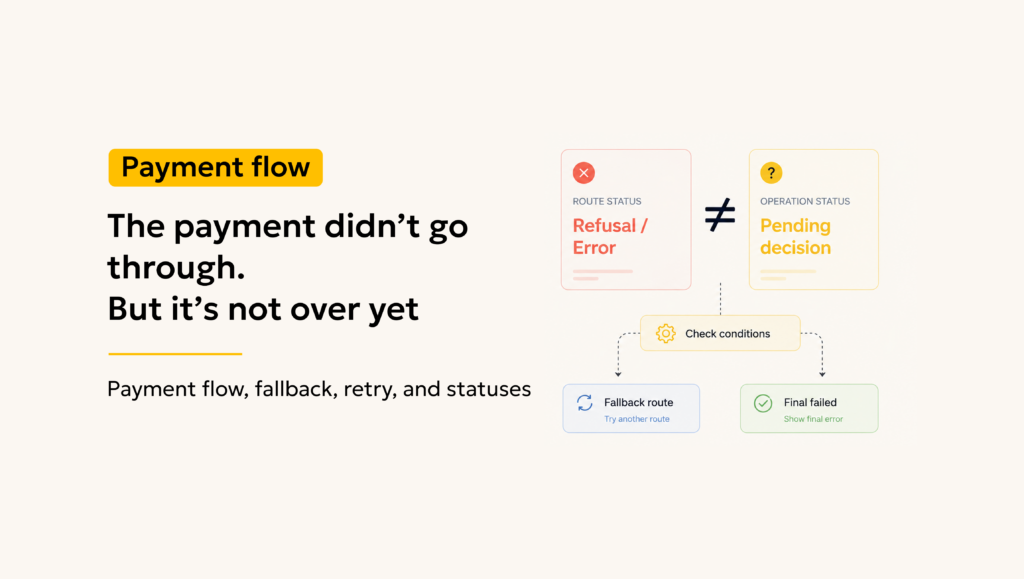
But for the payment flow, this is not always the same situation.
Sometimes the operation really needs to stop. For example, when the decline is related to the data, operation conditions, or a final response after which reprocessing is not allowed.
And sometimes only the selected processing route has failed. It could not accept or process the request, even though the operation itself can still be completed through another allowed path.
If the system does not distinguish between these cases, it can return failed payment too early. Not because the operation cannot be completed, but because the selected processing path did not work.
In this article, we look at
One error on the screen, different reasons inside the flow
On the screen, everything looks the same: the payment didn’t go through.
Inside the system, different reasons may be behind that result.
Operation data or conditions
If the issue is related to the data or operation conditions, the process needs to stop.
Response without reprocessing
Payment infrastructure may return a response after which reprocessing should not be launched.
Processing route error
A route may return a decline or an error after which the system can check an alternative scenario.
If these situations are mixed together, the flow behaves too roughly: receives a decline, shows an error, and ends the process.
A route failure does not always mean the whole operation should end as a failed payment.
Where a linear payment flow breaks
A simple scenario looks like this:
Linear logic ends the process too early
While payments go through successfully, the problem is almost invisible. The request is sent, the system receives a successful response, and the user sees the final status.
The weak point appears after a decline or error on the processing route.
At this moment, the system needs to understand what response came from the bank, provider, or internal processor, and what can be done next.
Usually, it is important to distinguish between:
If fallback is allowed, the system can check another processing path. If not, the flow should end and return the final status to the user.
Without this distinction, the user may receive an error not because the payment is impossible, but because the selected processing path did not work.
What the flow should do after a route failure
After one of the routes fails, the system should not automatically react with “show an error” or “retry the attempt”.
First, it needs to determine what response was received and whether processing can continue.
The flow should check
The reason for the decline
Whether the decline is related to operation data or conditions.
User step
Whether the user has already seen the payment confirmation step.
Alternative route
Which route is allowed and will not make the user scenario worse.
Final response
Whether the user should already be shown an error.
This matters for the user scenario. If a person has already moved to payment confirmation, and after a decline the system shows them another similar confirmation step through a different route, it can look suspicious and create distrust.
That is why fallback should take into account not only the technical response from the route, but also what the user has already seen.
Flow with condition checks
For the user, the path should not become longer. They do not choose a route, re-enter data, or start the payment again.
Why fallback should not be reduced to retry
In words, fallback sounds simple: the selected route did not work, so we try another one.
In payments, this logic quickly creates risks if it is not limited by rules.
Fallback should not be launched for every failed payment. If the decline is related to user data, a final response from the payment infrastructure, or a scenario where reprocessing is not allowed, the flow should stop.
An alternative route makes sense where the decline is related to the processing route or a technical failure, not to the possibility of completing the operation itself.
Fallback should not answer the question “what should we do after an error?” It should answer the question “what conditions make reprocessing allowed?”
That is why fallback should be based on rules. Not “something went wrong, let’s try again”, but “this type of response allows the next route”.
The same status may require different actions depending on routing rules and the state of the operation. In some cases, the process needs to stop immediately. In others, the system can check an alternative route. Without this logic, fallback turns into a set of random repeated attempts, and system behavior becomes hard to predict.
It is also important to control every processing attempt and store the operation history. This helps understand which steps have already been completed, what responses the system received, and at what point the process should end.
This way, fallback does not turn into chaotic retry. The system makes a limited and controlled attempt to continue the process instead of endlessly sending the same operation through different routes.
Why this is not added with one condition in the code
If the payment flow was originally linear, fallback is rarely something that can be added with a small fix.
It changes not only the place where the system selects a route. It also affects responses from payment infrastructure, statuses, stop rules, repeated attempts, the final response shown to the user, and managed routing rules.
At the same time, old scenarios should continue to work: successful payments should not change behavior, final declines should not go to fallback, and the alternative route should only be launched where reprocessing is allowed.
The complexity is not in having a second route. The complexity is in embedding it into the existing flow without losing control over the state of the operation.
What to check before launching fallback
Fallback adds new branches to the payment flow. They need to be tested separately, otherwise the system may become more complex without becoming more reliable.
Minimum set of scenarios
Special attention should be paid to scenarios where the old flow used to end immediately. This is where the new logic changes system behavior.
For example, if the alternative route also returns a decline, the flow should correctly end the process and return a result related to the reason for the last decline. Otherwise, the team gets an operation with an unclear state, and the user gets an unclear result.
Why managed routing rules are needed
If fallback rules are hardcoded, the payment team depends on development even for operational changes.
Processing conditions can change. One route may work for some scenarios and not for others. Some declines need to be considered final right away. Others can be sent to alternative processing.
That is why complex payment flows need managed routing rules.
They help define which scenarios go to fallback, which stop immediately, which routes are available under different conditions, and when the system should return a final decline.
Such rules may depend on the operation type, response status, available routes, and general processing conditions.
A rule should not answer the question “what should we do after an error?” It should answer the question “what conditions make reprocessing allowed?”
What this gives the product
The main value of this flow is that the system stops confusing a route failure with failure of the whole operation.
If the operation really cannot be completed, the user receives a final decline.
If the selected route could not process the request, but an allowed alternative scenario exists, the system can check another path without shifting the repeated attempt to the user.
This helps avoid ending the process prematurely: the user does not receive an error only because the selected route failed to process the request.
When the flow separates final declines, intermediate statuses, and fallback scenarios, it is easier for the team to understand where the operation stopped and why that decision was made.
In similar systems, this does not necessarily remove manual review completely. But it helps make it more focused: the team sees not just failed payment, but the chain of attempts, responses, and conditions that led to the final status.
What to check in your system
If the product has payments, request routing, or operations with statuses, start with one question:
What exactly happened on the processing route?
Five things worth checking
If the system does not distinguish between these cases, it can end the process too early. The user will see an error, while the team will have to review operations that could have gone through under another allowed logic.
A poor payment flow sees a decline and ends the process.
A good flow first understands what exactly failed. Only then does it decide whether to stop the operation or continue processing.
Want to review your payment flow?
If your system has payments, statuses, routing, or repeated attempts, it is worth checking where the flow may end the process too early.
El Pixel helps analyze such scenarios: from the payment scenario to the logic of statuses, errors, fallback, and processing rules.
We can review your flow and show where the system returns an error too early, where fallback can be limited by rules, and where disputed situations require manual review.